Activities
Organized Scientific Meetings and Conferences
- Int. Workshop: Developing a mathematical theory for co-evolutionary dynamical networks, May 30-31, 2023
Organizer of mini-workshop. -
Dynamics Days Europe, On-line (and Nice), France, August 2021 (post-poned due to COVID-19 outbreak)
Organization of mini-symposium: "Network dynamics with state-dependent interactions and applications to biology and medicine" -
SIAM Conference on Applications of Dynamical Systems, Snowbird, May 2021
Organization of mini-symposium: "Synchronization Dynamics in Networks"
With Christian Kuehn, TU Munich. -
Dynamics Days Digital 2020, on-line, August 2020
Organization of mini-symposium: "Dimensional Reduction Methods for Coupled Oscillator Networks: Future directions" -
International Workshop/Conference: "Oscillations, Transients and Fluctuations: Bridging Theory and Applications in Network Dynamics". Copenhagen, July 1-3, Denmark.
Organizer of conference with Susanne Ditlevsen (KU-Math), Mogens Høgh Jensen (KU-NBI), Mads Peter Sørensen (DTU Compute). -
International Conference on Mathematical Neuroscience ICMNS, Copenhagen, June 2019
Co-Organizer of conference. -
Dynamics Days Europe, Loughborough, United Kingdom, September 2018
Organization of mini-symposium: "Linking the dynamics of oscillator models to real-world networks" -
Dynamics Days Europe, Szeged, Hungary, June 2017
Organization of mini-symposium: "Complex patterns on networks" -
Rhythms in Complex Networks: From Theory to Experiment, 2014
Dynamical Systems Interdisciplinary Network & Niels Bohr Institute, University of Copenhagen
Main organizer of workshop. -
Dynamics Days Europe, Bayreuth, Germany, Sep 2014
Organization of mini-symposium: "Chimera States in Biological Systems and Technological Applications" -
Trait-based approaches to Ocean Life (International Workshop), Copenhagen, Aug 2013.
Co-organization of speed talks -
Dynamics Days Europe, Madrid, June 2013
Organization of mini-symposium: "Emergent Dynamics in Coupled Oscillators" -
SIAM Conference on Applications of Dynamical Systems, Snowbird, May 2013
Organization of mini-symposium: "Ensemble dynamics in experiments: from synchrony to chimera states"
International Workshop: Developing a mathematical theory for co-evolutionary dynamical networks, May 30-31, 2023
Location: MH:333, Matematikhuset, Centre for Mathematical Science, Lund University, Sweden
Date/Time: Tue May 30 and Wed May 31, 9.00-11.30 (break: 10.00-10.30)
The mini-workshop comprises of a series of talks on network dynamical systems spread over two half-days. Focus of the workshop is the study of adaptive networks, i.e., where dynamics occurs on both the nodes (vertices) and links (edges) on a network (graph) and may co-depend --- co-evolutionary networks in short. We discuss recent advances in the mathematical treatment and analysis in the finite and continuum limit descriptions (using graph operators) and applications in simplified as well as more realistic model applications, in particular, leaning towards applications in neuronal biological networks. Represented research fields include dynamical systems and bifurcation theory, graph theory, statistical physics, mathematical neuroscience, experimental neuroscience.
Speakers
- Serhiy Yanchuk, Potsdam I. f. Klimaforschung, DE
- Christian Kuehn, TU Munich, DE
- Chris Bick, Vrije U. Amsterdam, NL
- Chuang Xu, University of Hawaii, USA
- Konstantin Klemm, IFISC, ES
- Matthias Wolfrum, Weierstrass Institute, DE
- Marius Yamakou, FAU, DE
- Pär Halje, Lund University, SE
- Felix Augustsson, Lund University, SE
Programme (download link)
We gratefully acknowledge financial support from the Swedish Royal Physiographics Society.
International Workshop: Oscillations, Transients and Fluctuations in Complex Networks (OTFCN), July 1-3, 2019

OTFCN Workshop Website
Networks pervade all areas in nature and technology, from statistical physics over engineering to biology, from small to large. Complex networks play a vital role in in our every-day lives, coordinating complex interactions on the level of cells, organisms and of society. Interacting units in such networks are for instance wind turbine generators, neurons, and pacemaker cells in the heart. Such systems may exhibit collective dynamics such as synchronization and thus serve functions such as information processing in the brain or robust delivery of power in the electric grid. Depending on the context, the emergence or destruction of collective behaviors may be desired or undesired. However, these systems must often operate in a non-steady, out-of-equilibrium state; in fact, they are constantly subject to varying levels of (stochastic) fluctuations and heterogeneities which may lead to non-uniform dynamic behaviors within the network. This interdisciplinary workshop gathers researchers from biology, technology, physics and mathematics to better understand how fluctuations and transients spread through networks and affect their dynamics. We discuss the state-of the-art and emerging problems concerning dynamic interactions in complex dynamic networks, such as power grid dynamics, transport networks, brain/neural dynamics, systems biology from cell to body level, and the mathematical/physical theory of oscillation and network dynamics.
This is a collaboration with the Technical University of Denmark and the University of Copenhagen.
Speakers:
- Chris Bick, Dept. of Mathematics, U. Exeter, United Kingdom
- Andreas Daffertshofer, Vrije Universiteit Amsterdam, NL
- Krasimira Atanasova, Dept. of Mathematics, U. Exeter, United Kingdom
- Piotr Slowiński, Dept. of Mathematics, U. Exeter, United Kingdom
- Henrik Lindén, Dept. of Neuroscience, U. Copenhagen, Denmark
- Johnny Ottesen, Group for Mathematical Health and Disease Modeling, Dept. of Science, Roskilde University Center, Denmark
- Elisenda Feliu, Dept. of Mathematical Sciences, U. Copenhagen
- Marius Yamakou, Max Planck Institute for Mathematics in the Sciences, Leipzig, DE
- Camille Poignard, Dept. of Mathematics, U. Exeter, United Kingdom
- Alexander V. Ustinov, Physikalisches Institut, Karlsruhe Institute of Technology, Germany
- Frank Hellmann, Potsdam Institute for Climate Impact Research, DE
- Jason Hindes, Nonlinear Dynamical Systems Section, U.S. Naval Research Laboratory, Washington, USA
- Hyunsuk Hong, Dept. of Physics, Chonbuk National University, South Korea
- Hans True, Dept. of Applied Mathematics and Computer Science, TU of Denmark
- Mogens H. Jensen, Niels Bohr Institute, University of Copenhagen, Denmark
- Marc Timme, Chair for Network Dynamics, TU Dresden, Germany
- Jean-Guy Caputo, Laboratoire de Mathématiques de l’INSA Rouen, France
- Niels Grønbech-Jensen, Department of Mechanical and Aerospace Engineering and Department of Mathematics, UC Davis, USA
- Peter Ditlevsen, Niels Bohr Institute, Copenhagen University, Denmark
- Kim Sneppen, Niels Bohr Institute, Copenhagen University, Denmark
- Namiko Mitarai, Niels Bohr Institute, University of Copenhagen, Denmark
- Sandeep Krishna, National Centre for Biological Sciences, Tata Institute for Fundamental Research, Bangalore, India
- Konstantin Klemm, IFISC (CSIC-UIB), Campus Universitat de les Illes Balears, ES
- Chuang Xu, Classification and Dynamics of Continuous Time Markov Chains with Applications in Reaction Networks, Denmark
Programme (download link)
We gratefully acknowledge financial support from the Carlsberg Foundation.
International Workshop: Rhythms in Complex Networks - Theory Meets Experiment, September 1-3, 2014
To be held at the Niels Bohr Institute, University of Copenhagen, Denmark
This international workshop brings together theoretical, mathematical, but also experimental and computational researchers who are working on various topics related to oscillations in biological systems. The focus is on mathematical modeling and experimental phenomena around biological rhythms. The conference will be held in the historical halls of the Niels Bohr Institute at the University of Copenhagen. The event is hosted by the Dynamical Systems Interdisciplinary Network, University of Copenhagen, which is funded by the UCPH Excellence Programme for Interdisciplinary Research and the Center for Models of life, Niels Bohr Institute.
Confirmed Speakers
- Arkady Pikovsky, University of Potsdam, Germany
- Michael Rosenblum, University of Potsdam, Germany
- Diego Pazo, CSIC-UC, University of Cantabria, Spain
- Albert Goldbeter, Université Libre de Bruxelles, Belgium
- Hanspeter Herzel, Charite & Humboldt University, Germany
- Michael Zaks, Humboldt University Berlin, Germany
- Peter Ashwin, University of Exeter, United Kingdom
- Christian Kuehn, Vienna University of Technology, Austria
- Carlo Laing, Massey University, New Zealand
- Umberto Picchini, Center for Mathematical Sciences, Lund University, Sweden
- Marc Timme, Max Planck Institute for Dynamical Systems, Germany
- Eleni Katifori, Max Planck Institute for Dynamical Systems, Germany
- Rainer Dahlhaus, Institute of Applied Mathematics, University of Heidelberg, Germany
- Jordi Garcia-Ojalvo, Universitat Pompeu Fabra, Barcelona, Spain
- Natalia Janson, Loughborough University, United Kingdom
- Alexander Aulehla, EMBL, Heidelberg, Germany
- Johnny Ottesen, Roskilde University, Denmark
- Mogens H. Jensen, Niels Bohr Institute, University of Copenhagen, Denmark
- Peter Ditlevsen, Niels Bohr Institute, University of Copenhagen, Denmark
- Ala Trusina, Niels Bohr Institute, University of Copenhagen, Denmark
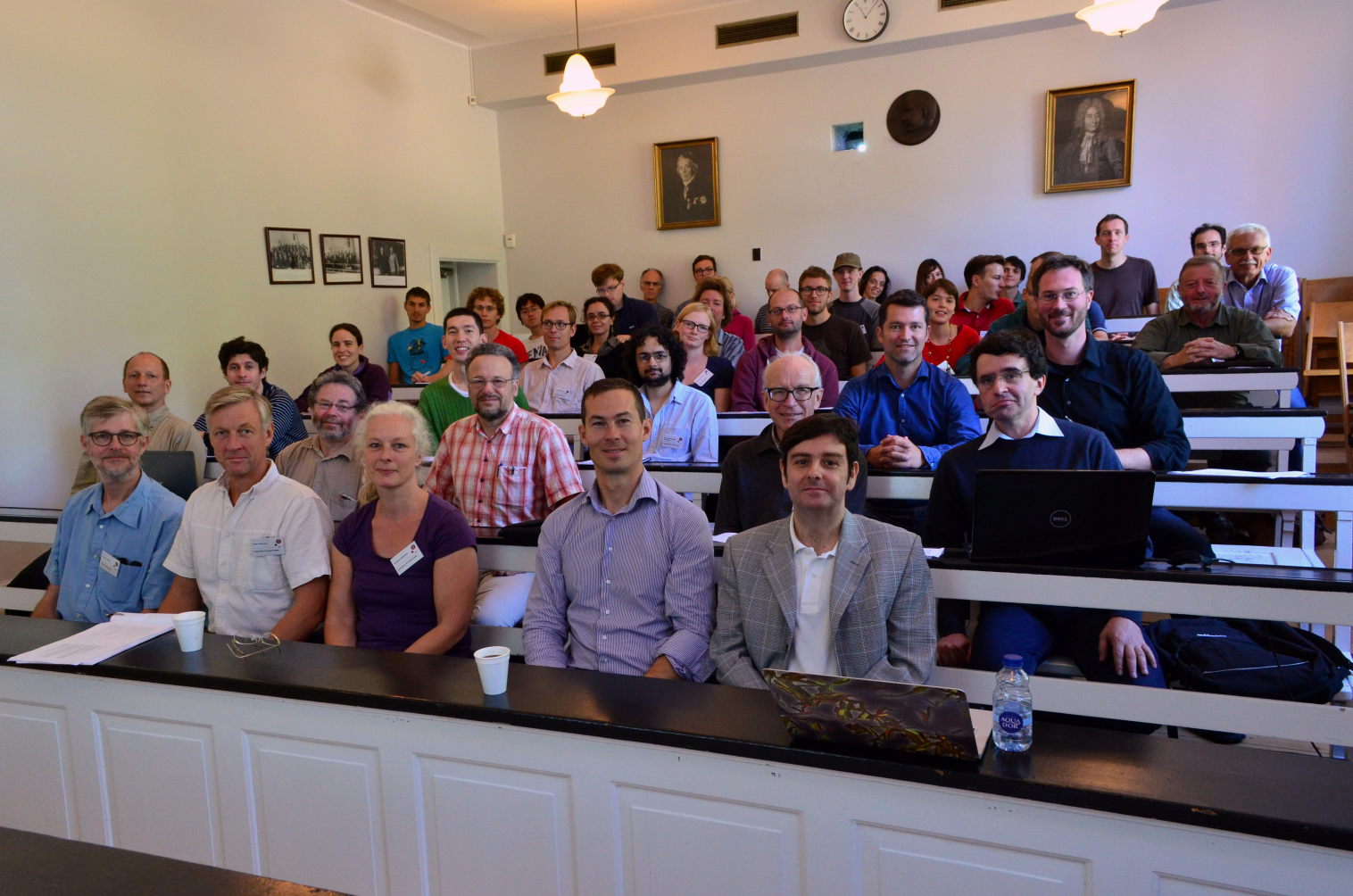
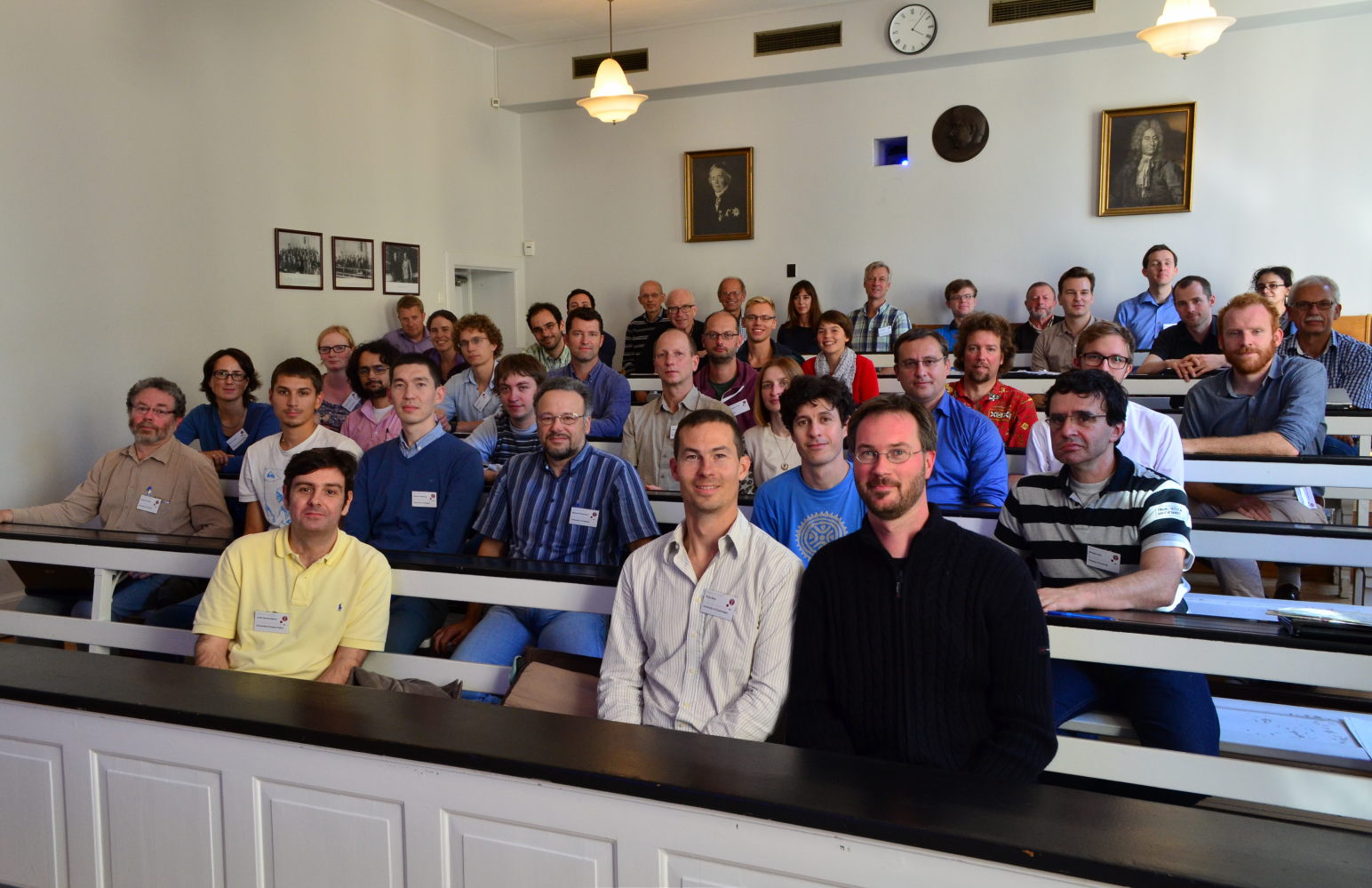
(click on picture to enlarge)
A link to a the workshop website is
here.
The B-Science Club
.. a collective to foster an exchange platform for science-minded
people and ideas across scientific fields ...
Have you ever felt like discussing informally over a beer your latest:
- crazy scientific idea,
- frontier science,
- or the complex natural systems that surrounds us?
This is a place to exchange ideas, cross scientific disciplines, build
bridges/collaborations between different institutions, talk about
stochastic highly non-linear academic politics, ...
We invite you to join us for a coffee or beer, or tea regardless whether you are a student, a postdoc, a
professor, or just anyone sharing an eager interest in science.
Note: This is a past event.
Location: MH:333, Matematikhuset, Centre for Mathematical Science, Lund University, Sweden
Date/Time: Tue May 30 and Wed May 31, 9.00-11.30 (break: 10.00-10.30)
The mini-workshop comprises of a series of talks on network dynamical systems spread over two half-days. Focus of the workshop is the study of adaptive networks, i.e., where dynamics occurs on both the nodes (vertices) and links (edges) on a network (graph) and may co-depend --- co-evolutionary networks in short. We discuss recent advances in the mathematical treatment and analysis in the finite and continuum limit descriptions (using graph operators) and applications in simplified as well as more realistic model applications, in particular, leaning towards applications in neuronal biological networks. Represented research fields include dynamical systems and bifurcation theory, graph theory, statistical physics, mathematical neuroscience, experimental neuroscience.
Speakers
- Serhiy Yanchuk, Potsdam I. f. Klimaforschung, DE
- Christian Kuehn, TU Munich, DE
- Chris Bick, Vrije U. Amsterdam, NL
- Chuang Xu, University of Hawaii, USA
- Konstantin Klemm, IFISC, ES
- Matthias Wolfrum, Weierstrass Institute, DE
- Marius Yamakou, FAU, DE
- Pär Halje, Lund University, SE
- Felix Augustsson, Lund University, SE
Programme (download link)
We gratefully acknowledge financial support from the Swedish Royal Physiographics Society.International Workshop: Oscillations, Transients and Fluctuations in Complex Networks (OTFCN), July 1-3, 2019

OTFCN Workshop Website
Networks pervade all areas in nature and technology, from statistical physics over engineering to biology, from small to large. Complex networks play a vital role in in our every-day lives, coordinating complex interactions on the level of cells, organisms and of society. Interacting units in such networks are for instance wind turbine generators, neurons, and pacemaker cells in the heart. Such systems may exhibit collective dynamics such as synchronization and thus serve functions such as information processing in the brain or robust delivery of power in the electric grid. Depending on the context, the emergence or destruction of collective behaviors may be desired or undesired. However, these systems must often operate in a non-steady, out-of-equilibrium state; in fact, they are constantly subject to varying levels of (stochastic) fluctuations and heterogeneities which may lead to non-uniform dynamic behaviors within the network. This interdisciplinary workshop gathers researchers from biology, technology, physics and mathematics to better understand how fluctuations and transients spread through networks and affect their dynamics. We discuss the state-of the-art and emerging problems concerning dynamic interactions in complex dynamic networks, such as power grid dynamics, transport networks, brain/neural dynamics, systems biology from cell to body level, and the mathematical/physical theory of oscillation and network dynamics.
This is a collaboration with the Technical University of Denmark and the University of Copenhagen.
Speakers:
- Chris Bick, Dept. of Mathematics, U. Exeter, United Kingdom
- Andreas Daffertshofer, Vrije Universiteit Amsterdam, NL
- Krasimira Atanasova, Dept. of Mathematics, U. Exeter, United Kingdom
- Piotr Slowiński, Dept. of Mathematics, U. Exeter, United Kingdom
- Henrik Lindén, Dept. of Neuroscience, U. Copenhagen, Denmark
- Johnny Ottesen, Group for Mathematical Health and Disease Modeling, Dept. of Science, Roskilde University Center, Denmark
- Elisenda Feliu, Dept. of Mathematical Sciences, U. Copenhagen
- Marius Yamakou, Max Planck Institute for Mathematics in the Sciences, Leipzig, DE
- Camille Poignard, Dept. of Mathematics, U. Exeter, United Kingdom
- Alexander V. Ustinov, Physikalisches Institut, Karlsruhe Institute of Technology, Germany
- Frank Hellmann, Potsdam Institute for Climate Impact Research, DE
- Jason Hindes, Nonlinear Dynamical Systems Section, U.S. Naval Research Laboratory, Washington, USA
- Hyunsuk Hong, Dept. of Physics, Chonbuk National University, South Korea
- Hans True, Dept. of Applied Mathematics and Computer Science, TU of Denmark
- Mogens H. Jensen, Niels Bohr Institute, University of Copenhagen, Denmark
- Marc Timme, Chair for Network Dynamics, TU Dresden, Germany
- Jean-Guy Caputo, Laboratoire de Mathématiques de l’INSA Rouen, France
- Niels Grønbech-Jensen, Department of Mechanical and Aerospace Engineering and Department of Mathematics, UC Davis, USA
- Peter Ditlevsen, Niels Bohr Institute, Copenhagen University, Denmark
- Kim Sneppen, Niels Bohr Institute, Copenhagen University, Denmark
- Namiko Mitarai, Niels Bohr Institute, University of Copenhagen, Denmark
- Sandeep Krishna, National Centre for Biological Sciences, Tata Institute for Fundamental Research, Bangalore, India
- Konstantin Klemm, IFISC (CSIC-UIB), Campus Universitat de les Illes Balears, ES
- Chuang Xu, Classification and Dynamics of Continuous Time Markov Chains with Applications in Reaction Networks, Denmark
Programme (download link)
We gratefully acknowledge financial support from the Carlsberg Foundation.International Workshop: Rhythms in Complex Networks - Theory Meets Experiment, September 1-3, 2014
To be held at the Niels Bohr Institute, University of Copenhagen, Denmark
This international workshop brings together theoretical, mathematical, but also experimental and computational researchers who are working on various topics related to oscillations in biological systems. The focus is on mathematical modeling and experimental phenomena around biological rhythms. The conference will be held in the historical halls of the Niels Bohr Institute at the University of Copenhagen. The event is hosted by the Dynamical Systems Interdisciplinary Network, University of Copenhagen, which is funded by the UCPH Excellence Programme for Interdisciplinary Research and the Center for Models of life, Niels Bohr Institute.
Confirmed Speakers
- Arkady Pikovsky, University of Potsdam, Germany
- Michael Rosenblum, University of Potsdam, Germany
- Diego Pazo, CSIC-UC, University of Cantabria, Spain
- Albert Goldbeter, Université Libre de Bruxelles, Belgium
- Hanspeter Herzel, Charite & Humboldt University, Germany
- Michael Zaks, Humboldt University Berlin, Germany
- Peter Ashwin, University of Exeter, United Kingdom
- Christian Kuehn, Vienna University of Technology, Austria
- Carlo Laing, Massey University, New Zealand
- Umberto Picchini, Center for Mathematical Sciences, Lund University, Sweden
- Marc Timme, Max Planck Institute for Dynamical Systems, Germany
- Eleni Katifori, Max Planck Institute for Dynamical Systems, Germany
- Rainer Dahlhaus, Institute of Applied Mathematics, University of Heidelberg, Germany
- Jordi Garcia-Ojalvo, Universitat Pompeu Fabra, Barcelona, Spain
- Natalia Janson, Loughborough University, United Kingdom
- Alexander Aulehla, EMBL, Heidelberg, Germany
- Johnny Ottesen, Roskilde University, Denmark
- Mogens H. Jensen, Niels Bohr Institute, University of Copenhagen, Denmark
- Peter Ditlevsen, Niels Bohr Institute, University of Copenhagen, Denmark
- Ala Trusina, Niels Bohr Institute, University of Copenhagen, Denmark
(click on picture to enlarge)
A link to a the workshop website is here.
The B-Science Club
.. a collective to foster an exchange platform for science-minded people and ideas across scientific fields ...
Have you ever felt like discussing informally over a beer your latest:
- crazy scientific idea,
- frontier science,
- or the complex natural systems that surrounds us?
We invite you to join us for a coffee or beer, or tea regardless whether you are a student, a postdoc, a professor, or just anyone sharing an eager interest in science.
Note: This is a past event.